
Confidence in Stocking Part 1: A Smart Approach to Spare Parts Inventory
This article was originally published in Waste Advantage Magazine.
Part 1: Forecast Inventory Using Data and Real-World Insights
In the waste industry, uptime is everything. A truck down situation can quickly escalate from an inconvenience to a loss of service—and, ultimately, increased costs and lost revenue. Keeping spare parts on hand is not just a maintenance strategy; it is a critical component of operational efficiency and in how reliably a fleet can serve its communities.
Confidence in stocking and inventory planning is about knowing which parts matter most and when, smart purchasing without tying up capital unnecessarily and maintaining strong OEM partnerships. Based on years of working closely with distributors, private and public waste haulers and municipal sanitation departments, here are some best practices for parts inventory management that support continuity, productivity, and long-term success.
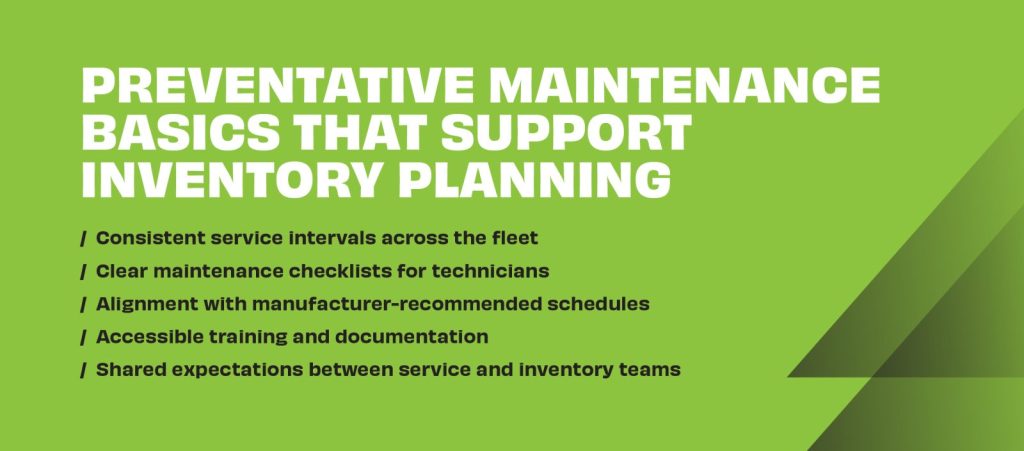
Basing inventory decisions on historical usage data helps show trends to determine appropriate stocking levels for all equipment in a fleet. Prioritizing manufacturer-recommended spare parts and aligning with preventative maintenance schedules can help dial-in forecasting. Preventive maintenance does more than reduce breakdowns. It provides a practical framework, along with considering parts with long lead times and parts commonly needed in emergency situations. Work with OEM parts manufacturers and suppliers, when possible, to create inventory plans tailored to a fleet’s specific needs.
There are numerous parts inventory management systems that track data and offer reporting dashboards, and that can automate and optimize inventory management processes. Automation eliminates guesswork and improves stocking efficiency over time, especially for multi-location distributors and haulers.
Most ERP platforms can also track usage by customer, region, or parts categories. ERP systems with integrated inventory management tools can streamline restocking by setting min/max thresholds and generating reorder alerts. Tracking usage by geography or customer profile also improves accuracy and responsiveness.
Even operations without advanced systems can start with available data. Classify inventory as critical, essential, or non-critical. Prioritize critical parts, such as hydraulic pumps and essential electrical components, that are key to maintaining uptime. Non-critical or slow-moving items can be ordered as needed. This tiered approach can help reduce investment in low-priority stock and build inventory continuity.
Key Takeaways:
- Historical usage data reveals stocking patterns and helps right-size inventory levels across your fleet
- Inventory management systems eliminate guesswork through automation and data-driven decision-making
- A tiered classification system (critical/essential/non-critical) prioritizes high-impact parts while reducing unnecessary investment in slow-moving inventory
- ERP platforms with integrated tools set automated thresholds, trigger reorder alerts, and track usage by geography or customer segment to scale efficiency
Reduce Delays and Errors with Identification Tools
Accurate parts identification prevents delays, reduces returns, and supports efficient repairs. Visual identification tools can help reduce errors. Exploded diagrams, parts kit schematics, and clear documentation minimize miscommunication between service and inventory teams. They also support faster training for new technicians and improve consistency across shifts.
Barcoding and RFID systems improve inventory tracking, reduce manual errors, and speed up receiving and picking processes. These tools, when integrated with inventory management software or ERP systems, also generate more accurate usage data for forecasting, KPI tracking and reporting.
Common Inventory Mistakes to Avoid
Even well-run operations encounter challenges. The following missteps consistently undermine inventory confidence:
- Understocking critical parts. Frequent expedited shipments are a signal that stocking plans need adjustment.
- Treating all parts equally. Inventory should be prioritized based on operational impact, not shelf space.
- Underusing available tools. ERP systems, visual guides, and manufacturer resources often go untapped.
- Working in silos. Gaps between service and inventory teams slow problem-solving and increase errors.
- Holding obsolete inventory. Parts incompatible with current equipment should be retired promptly.
Avoiding these pitfalls strengthens continuity and improves cost control over time.
Take the Next Step
Explore New Way Parts & Service: https://www.newwaytrucks.com/parts-service/
For New Way Distributors
Log in to the distributor portal to order parts, track inventory, and streamline restocking.
https://www.newwaytruckparts.com
Charles Mintz is Director of OEM Parts and Aftermarket for New Way Trucks. He has more than 30 years of experience in manufacturing, supply chain, warehousing, distribution and transportation—most recently with Goodyear and Cooper Tire & Rubber Company before joining New Way. Charles can be reached at (330) 224-6596 or e-mail [email protected].