
Confidence in Stocking Part 2: Execution, Communication, and Long-Term Accuracy
This article was originally published in Waste Advantage Magazine.
In the first installment on spare parts inventory management, we explored how to forecast stocking levels using data, preventive maintenance schedules, and tiered classification systems. That foundation—knowing what to stock and why—is essential. But confidence in stocking goes deeper. It requires the right systems to track and identify parts accurately, clear communication between your service and inventory teams, and the discipline to continuously refine your approach.
In this second part, we’ll examine the tools and practices that transform inventory data into operational reliability, reduce costly delays and errors, and help you avoid the pitfalls that undermine even well-managed operations.
Regular Inventory Auditing Supports Long-term Accuracy
Even before implementing technology like RFID or barcoding systems, routine cycle counts and spot checks are essential to maintaining inventory accuracy. Shrinkage, misplaced parts, and outdated information can lead to stockouts or overstocking.
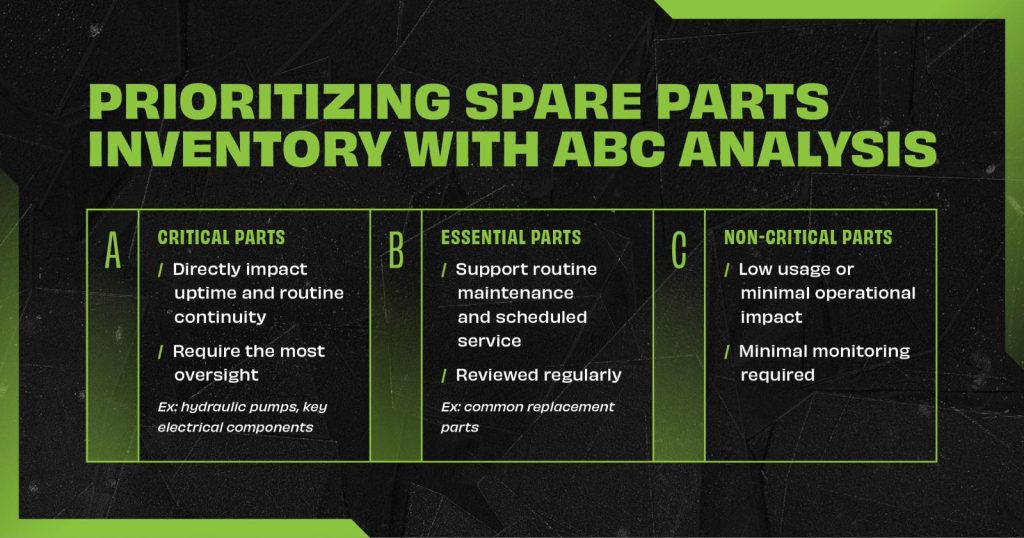
Cycle counts and spot checks help identify issues early. As a baseline, fleets should aim to review inventory at least annually, with more frequent checks for high-value or high-turn items. Apply the ABC analysis method to categorize inventory items, focusing more attention on the “A” items with the highest value and most frequently requested items.
Auditing also creates an opportunity to retire obsolete inventory. Parts that are no longer compatible with active equipment models should be returned or removed promptly. Holding onto outdated components ties up space and capital while adding unnecessary complexity.
Good Communication Strengthens Inventory Planning
Using information from your internal experts augments your data and supports effective parts inventory management. Technicians often recognize recurring issues before you may look for them in a report. Establish regular communication between inventory and service teams to identify patterns, improve forecasting and support training or documentation needs.
Collecting feedback from the field helps inform training needs, documentation updates, and parts kit development. When patterns are identified and addressed proactively, repeat failures become less common.
Regular communication with your technicians can also help guide emergency stock planning to prepare for truck down situations, extreme weather, or parts shortages. Maintaining a buffer of critical components is essential for high-demand periods and geographic regions with logistical constraints, and consistent communication with parts manufacturers and suppliers is key to staying up to date with any potential supply chain disruptions that may affect inventory levels.
While emergency readiness is important, preventive maintenance can reduce emergency needs and supports overall fleet reliability. While every fleet manages service differently, consistency is key. Offer checklists and training materials that encourage adherence to established schedules.
Regularly monitor other manufacturer updates to ensure alignment with current parts specifications and actively retire obsolete inventory—especially if equipment models are upgraded.
Using industry benchmarks on fill rates and inventory turnover and monitoring stockout frequency will provide further insights to influence inventory management plans. When industry-specific benchmarks are unavailable, use adjacent sectors such as automotive for comparative insight.
Key Takeaways:
- Internal expertise from technicians identifies patterns and improves forecasting before data alone reveals them
- Regular communication between inventory and service teams informs training, documentation, and emergency stock planning
- Proactive pattern identification reduces repeat failures and supports supply chain resilience during shortages or extreme weather
- Track industry benchmarks on fill rates, inventory turnover, and stockout frequency to refine your inventory strategy
Keep Your Trucks Running
With any inventory management plan, the objective is not just to meet a standard, it is to identify gaps and refine processes over time. Work in close collaboration with your OEMs and suppliers to anticipate needs, support rebuild programs and develop stocking strategies that improve uptime and efficiency. Stocking parts is not the end goal. It is about giving teams the confidence to keep trucks running and communities clean.
Take the Next Step
Explore New Way Parts & Service: https://www.newwaytrucks.com/parts-service/
For New Way Distributors
Log in to the distributor portal to order parts, track inventory, and streamline restocking.
https://www.newwaytruckparts.com
Charles Mintz is Director of OEM Parts and Aftermarket for New Way Trucks. He has more than 30 years of experience in manufacturing, supply chain, warehousing, distribution and transportation—most recently with Goodyear and Cooper Tire & Rubber Company before joining New Way. Charles can be reached at (330) 224-6596 or e-mail [email protected].