
Refuse Truck Maintenance Tips to Keep Fleets On Route
Fleet managers know: when a truck goes down, it’s more than an inconvenience. It’s a ripple effect that leads to routes falling behind, crews adjusting on the fly, and delays in service. What could have been handled early turns into a bigger, more expensive problem.
The reality? Most breakdowns don’t come out of nowhere, and can usually be traced back to small things. New Way’s service team sees missed maintenance opportunities every day that could either catch issues early or even avoid them entirely.
The good news? There are things you can control, and here’s where to focus.
1. Start with clean equipment
Keeping equipment clean is one of the most important things you can do. Regularly washing cylinders makes it easier to monitor key components. When trucks aren’t kept clean, it’s harder to spot leaks, check lubrication points, and keep contaminants out of the system.

“You should think of your truck like any other tool. You wouldn’t put a dirty wrench back in the drawer and expect it to work the same next time,” explained New Way service manager, Jimmie Veach. “The same goes for your trucks.”
Keep these considerations in mind when washing your refuse truck:
- Wash down cylinders, blades, and trough areas
- Clear debris before it packs in and causes wear
- Make cleaning part of the routine, not an afterthought
It’s simple work, but it sets the foundation for everything else.
2. Protect your hydraulic system
Hydraulics are doing the heavy lifting every day. When they’re not right, you know it. A lot of maintenance issues come back to fluid that’s breaking down, filters that aren’t doing their job, or systems running hotter than they should. When flow is restricted, everything works harder. That creates heat which, over time, starts breaking things down across the system (and not just in one spot).
Seasonal conditions don’t help. Cold weather can affect controls and air systems while heat and poor circulation can push systems past their limits.
Staying ahead here means:
- Checking hoses and connections regularly
- Keeping an eye on fluid condition
- Changing filters before they become a problem
3. Don’t skip the basics
“A lot of customers will run a truck until it breaks instead of staying ahead of it,” Jimmie shared. “Things like arm adjustments, grease intervals, and routine checks aren’t hard to do, but take consistency and can make a big difference in uptime.”
Everyday basics tend to get overlooked, which can lead to bigger issues down the road.
The fleets that avoid bigger problems are usually the ones who stick to a schedule, handle small fixes early, and build maintenance into the day-to-day. Nothing fancy, just doing the work.
4. Make simple walkarounds routine
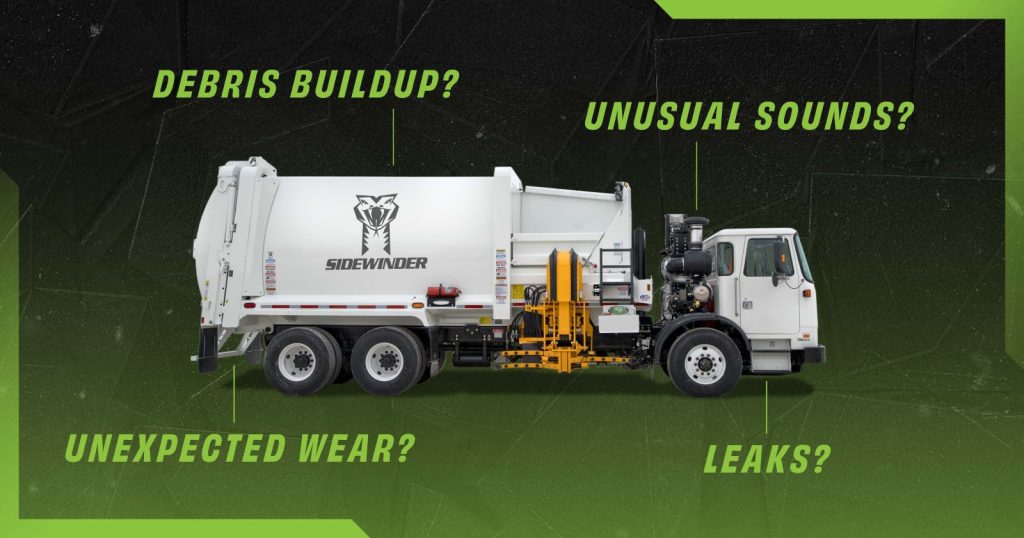
You don’t need a deep teardown to catch most issues early. Instead, a simple walkaround can tell you a lot:
- Is there a leak starting?
- Is something wearing faster than it should?
- Is corrosion spreading from salt and debris buildup?
- Does anything look or sound off?
Clean equipment makes this easier, but familiarity matters even more. Knowing your trucks helps you recognize when something isn’t right. And when that happens, New Way’s service team is there to help you troubleshoot and keep things moving.
Preventative maintenance checklist for refuse trucks
And for those who want a comprehensive list to reference, here are preventative maintenance items broken down by frequency:
Daily pre-trip inspection
- Secure your own safety: check seat belt, mirrors, controls, fire extinguisher, and PPE.
- Walk around the truck: check for leaks, damage, and overall truck body condition. Check under the truck and around the compactor body, hydraulic lines, and tailgate for oil, fuel, coolant, or hydraulic leaks.
- Check fluid levels: verify engine oil, coolant, transmission fluid, hydraulic oil, diesel exhaust fluid (DEF), and washer fluid are at the appropriate levels.
- Test brakes and air system: test service brakes, parking brake, air pressure build-up, and listen for air leaks.
- Inspect tires and wheels: check tire pressure, tread, sidewalls, wheel condition, and lug nuts because curb strikes and constant turning in neighborhoods can accelerate tire and wheel damage.
- Look at lights, signals, mirrors, and glass: confirm headlights, brake lights, turn signals, strobe/beacons, mirrors, windshield, and wipers work so the truck stays visible and the driver has clear sightlines in tight residential routes.
- Test warning devices, including the horn, backup alarm, and cameras.
- Verify functionality of refuse body and compactor: inspect hopper, packer blade, tailgate locks, pins, interlocks, lift arms, carts/lift forks, and any safety props or locks before use.
Weekly maintenance tasks
- Wash the truck and undercarriage: clean the body, frame, compactor area, and underside to remove corrosive waste residue, leachate, salt, and grit.
- Grease fittings and moving points: lubricate hinges, pins, lift arms, rollers, and other pivot points.
- Inspect hoses, belts, and wiring: look for cracking, abrasion, loose clamps, chafing, and heat damage since vibration and repeated loading cycles are hard on these components.
- Check the battery and electrical systems: clean terminals, check charge, and inspect battery hold-downs and connections.
- Top off and recheck all fluids: confirm any low fluids are corrected and look again for fresh leaks after the truck has been in service.
- Test safety devices and body function: run the compactor, tailgate, lift system, and any interlocks through a functional test to catch slow response, abnormal noise, or drift before it becomes an outage.
Monthly maintenance tasks
- Engine oil and filter service: change oil and filters on schedule, as refuse trucks spend long hours idling, stopping, and starting, which drives contamination and engine wear.
- Manage air and fuel filters: inspect or replace filters as needed to keep dust, moisture, and fuel contamination from affecting performance.
- Hydraulic system service: check hydraulic filter condition, inspect hoses and fittings, and perform pressure checks for internal wear, as the packer, lift, and tailgate depend on reliable hydraulics.
- Inspect the cooling system: check radiator, hoses, coolant condition, clamps, and fan operation.
- Conduct a deeper inspection of the brake and air-system: look over air lines, chambers, slack adjusters, and brake wear more thoroughly than a daily walk-around.
- Check compactor and body hardware: inspect welds, mounting bolts, packer blades, tailgate seals, latch hardware, and lift-arm pins for looseness or fatigue because repeated compaction cycles create structural wear.
- Review notes for trends: review DVIRs and repair notes to spot recurring issues like hydraulic leaks, overheating, or tire problems so you can fix root causes instead of chasing repeat failures.
When something does go wrong, support matters
Even with the best refuse truck maintenance program, things happen. That’s where having the right support makes a difference.
When every minute matters, New Way has local distributors on call and field service techs available on site.
“The first line of defense is the local distributor,” said Jimmie. “From there, it’s constant communication with our network until the problem is fixed. We won’t stop until a broken down truck is up and moving as quickly as possible.”
Take the next step
At the end of the day, it all boils down to doing the simple, routine work that keeps everything moving. From keeping equipment clean to staying on top of key systems and handling small issues before they slow service—it all adds up.
And when you need help, work with a team that’s ready to jump in and get it done. Because that’s what this industry demands: keeping trucks on route.
Explore New Way Parts & Service: https://www.newwaytrucks.com/parts-service/
Jimmie Veach is Service Manager at New Way Trucks, based in Booneville, Mississippi. He leads a team of service technicians supporting refuse fleets across the field. Jimmie can be reached at 580.231.7555 or [email protected].