
The Right Truck in the Right Place
What Fleet Managers Need to Know Before They Spec Their Next Truck
I spend a lot of time thinking about how trucks fail people—not mechanically, but strategically. A fleet manager makes a spec decision, the truck shows up, and somewhere between the order form and the route, something doesn’t fit. The truck is too big for the streets. The wheelbase is too long for the turns. The body is packed out before the route is done, or the driver is backing up constantly because the geometry just isn’t right for where that truck actually has to go.
Most of the time, that’s not a truck problem. It’s a spec problem. And most spec problems start the same way: the conversation focused on the truck before it focused on the route.
Having the right truck means your crew can work more safely, efficiently, and reliably. I had the chance to dig into this with haulers and fleet managers directly last year at RCon, and here’s the conversation every fleet manager should have before they sign off on their next order.
Table of Contents
- Route density has two dimensions—and both matter
- The case against going bigger by default
- Safety built in before the truck ever leaves the manufacturing floor
- Technology that works with—not against—the driver
- Under-CDL units and the driver shortage reality
- Continue the convo at Waste Leadership Summit
Route density has two dimensions—and both matter
When I talk about route density, I’m not just referring to how many stops a driver makes per mile. Route density has two distinct dimensions that directly impact how you should spec: geographic density and refuse density.
Geographic density refers to the physical complexity of the route. Tight urban grid? Suburban layout full of cul-de-sacs? Long rural stretches between stops? Each of those environments puts different demands on wheelbase, turning radius, and arm reach.
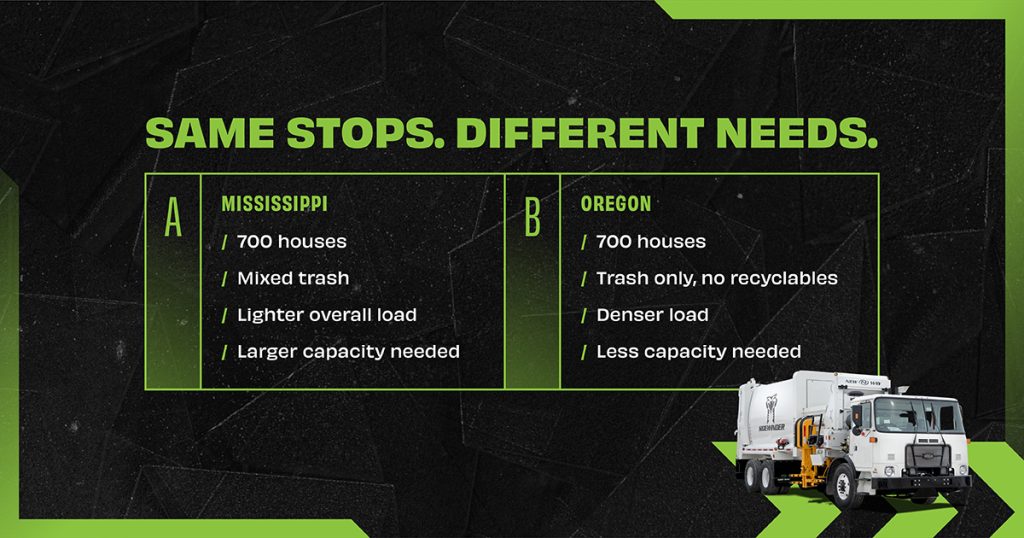
Refuse density is the weight and composition of the actual load. For example, a route with 700 homes in Mississippi is not the same as a route with 700 homes in Oregon. In the Southeast, where recycling programs are less prevalent, that load is predominantly mixed trash. In the West and Northeast, the garbage stream is actually heavier because the recyclables have been separated out. Two routes with the same home count can need meaningfully different trucks based purely on what those households throw away.
Both dimensions—geographic and compositional—shape the spec decision. And both have direct safety implications.
Key Takeaways:
- Route density has two critical dimensions: geographic density (route layout and stop spacing) and refuse density (weight/composition of collected material).
- Geographic density directly affects truck maneuverability needs, including wheelbase, turning radius, and arm reach.
- Refuse density can vary significantly between regions even with identical home counts, changing payload demands and truck requirements.
- Both route layout and waste composition should drive spec decisions because each has operational and safety implications.
The case against going bigger by default
It’s tempting to default to a larger truck. A 31-cubic yard body sounds capable. Versatile. The safe choice in the abstract. But if it’s running a route where it’s only packing out at half capacity, that truck is actually working against you.
Here’s the chain: extra capacity means a heavier chassis, which means a longer wheelbase, a wider turning radius, and more backing maneuvers. (Backing is one of the highest-risk moments in refuse collection.) Reducing the number of times a driver has to back up is as much of a safety gain as it is efficient.
I’ve been on demos where we put a properly spec’d, short-wheelbase truck into a high-density urban route, and made it through a full day with only three backing events. The fleet was used to doing it constantly. Right-sizing the truck changed the math entirely.
For automated side loader routes with heavy cul-de-sac density, arm reach works the same way. A 12-foot reach eliminates backing situations that a 6- or 9-foot arm creates.
I’d encourage fleet managers to target a truck running at roughly 85% capacity for its specific route. Enough payload, right-sized chassis, built to navigate the actual streets it’s going to run every day.
Key Takeaways:
- Oversizing a truck can create operational and safety drawbacks.
- Larger bodies often require longer wheelbases and wider turning radiuses, increasing the need for high-risk backing maneuvers.
- Fleet specs should balance payload and maneuverability, with a target of roughly 85% capacity utilization for the route.
Safety built in before the truck ever leaves the manufacturing floor
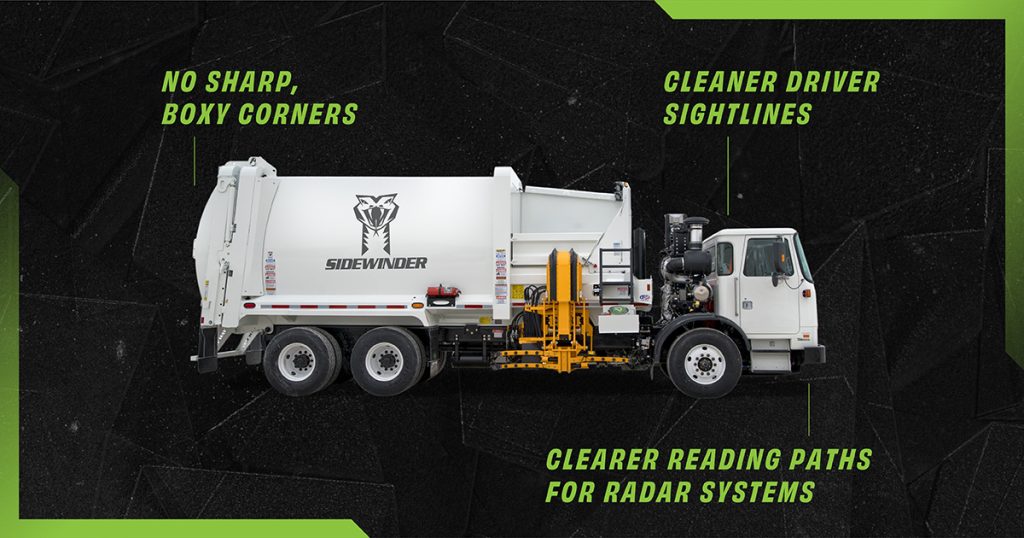
There’s the technology you can see, and there’s practical engineering that makes the tech actually work. Our bodies are also designed so that radar systems and active braking have clear reading paths. More intentional curvature gives the driver clearer sightlines and reduces visual obstruction. Weight distribution decisions affect frame specifications and safe payload limits. These factors aren’t afterthoughts—they’re built into the body from the start to help your crews on their route every day.
And then there’s serviceability. Every truck will break down at some point, the question is whether it can be serviced safely when it does. To help address this, we’ve moved our electrical harnesses to eye level so that mechanics don’t need ladders. We’ve simplified wiring so troubleshooting is faster and less error-prone. The goal is a safe environment for whoever is working on that truck, not just whoever is driving it.
Safety technology has evolved significantly over the past ten years. From mirrors, to backup cameras, to passive radar, to active braking systems that apply automatically when something enters the detection zone—each step has meaningfully reduced risk. New Way was among the first body manufacturers to make backup cameras standard, and our integration work with chassis OEM systems is ongoing. The body has to let that technology do its job.
Key Takeaways:
- Effective safety technology depends on body engineering that supports visibility, radar performance, braking systems, and safe weight distribution from the ground up.
- Serviceability is a core safety consideration—design choices like eye-level electrical harnesses and simplified wiring reduce repair risk and downtime for technicians.
- Modern refuse truck safety has evolved from passive visibility tools to active intervention systems, making proper integration between the truck body and chassis technology essential.
Technology that works with—not against—the driver
At the same time, more tech, more screens, and more alerts that demand attention can be more of a safety detriment than a solution. The key here is consolidation. For example, there are digital interfaces that surface information only when the driver needs it (like maintenance alerts or safety triggers), and keep a simplified screen as a default. The goal is to reduce the number of distractions as much as possible, not pack on a bunch of new features for features’ sake.
Interlocks represent a real evolution in how we build safety into the body. Older units were air-controlled or cable-controlled—you pressed the button, something moved, no condition check. Today, integrated electronics verify that all conditions are met before anything actuates. If you press the button and nothing moves, that’s the system working correctly. Something isn’t right, and it’s protecting the driver from a dangerous outcome.
Driver-facing and forward-facing cameras have gotten a bad reputation in some corners of the industry, but that’s also shifting. The footage from these systems is most often used to protect drivers—providing evidence that they operated safely when an incident wasn’t their fault. We’ve moved past the surveillance conversation. This is protection.
Key Takeaways:
- Safety technology is only effective when it minimizes driver distraction through simplified, consolidated interfaces rather than adding unnecessary complexity.
- Modern electronic interlocks improve safety by preventing unsafe actions unless all operating conditions are verified and met.
Under-CDL units and the driver shortage reality
The driver pool is tighter than it’s been. CDL requirements create a supply constraint, turnover is high, and fleets are regularly onboarding people who are new to the equipment. That’s the reality, and spec decisions need to account for it.
New Way has invested in under-CDL units specifically for this reason. Our under-CDL Wolverine Automated Side Loader runs the same control system and the same control logic as the Sidewinder Automated Side Loader—our flagship product. A driver who learns on the smaller unit transitions to the larger one with a much smaller gap. The interface is familiar. The experience transfers. That consistency is a safety outcome.
The interlocks serve the same function. They’re designed to catch what an inexperienced operator might miss. I’ll be the first to admit that I’m not an expert automated side loader operator—and I test our systems myself specifically because of that. If the interlocks keep things safe when I’m running the arm, they’ll do the same for a driver on day one. That’s what we’re building toward.
Key Takeaways:
- Tight driver availability and high turnover make operator-friendly truck specs and safety systems more important than ever.
- Consistent control systems across under-CDL and larger units help drivers transition more safely and confidently between vehicles.
- Safety interlocks also protect inexperienced operators by preventing unsafe actions before they happen.
Tyler White is a Product Manager at New Way Trucks. He brings a background in mechanical engineering and focuses on the strategic bridge between engineering capabilities and the voice of the customer. Tyler serves on the ANSI Z245 Standards Committee and has spoken at Waste Expo, RCon, and ACT Expo. He can be reached at 662.210.0444 or [email protected].